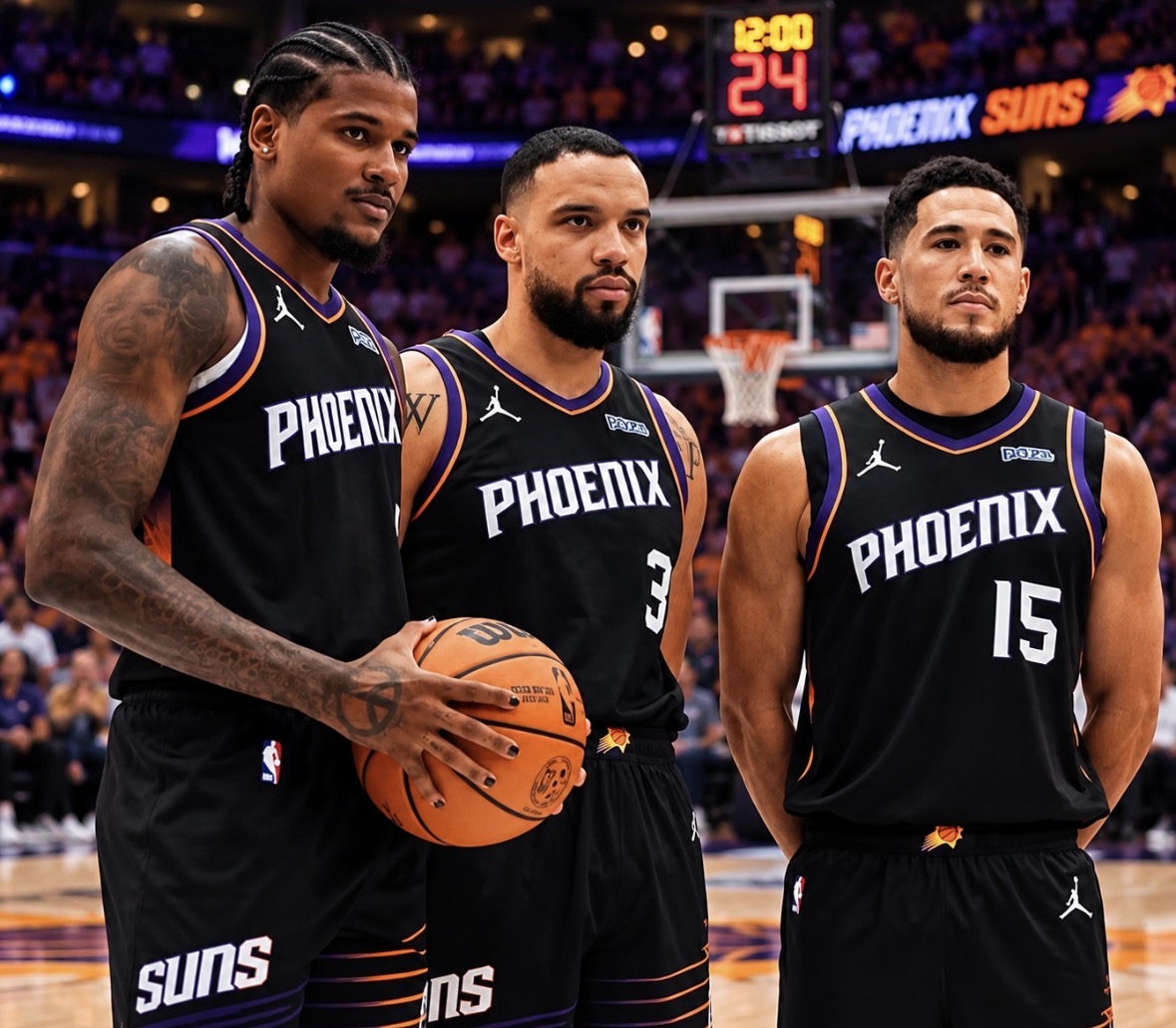
The Phoenix Suns enter the 2026–27 NBA season facing a challenge that goes beyond winning basketball games. They must prove that the foundation established last season can develop into something sustainable, competitive, and capable of challenging the Western Conference’s elite.
Phoenix finished the 2025–26 regular season with a 45–37 record, earning a playoff appearance before suffering a first-round sweep against the Oklahoma City Thunder. Although the postseason ended in disappointment, the Suns demonstrated significant progress under head coach Jordan Ott.
The transformation was especially noticeable defensively. Phoenix improved from one of the NBA’s weakest defensive teams in 2024–25 to a top-10 unit last season. The Suns developed a more aggressive mentality, increased their defensive pressure, and created additional scoring opportunities through turnovers and offensive rebounds.
However, regular-season improvement does not automatically translate into postseason success.
The Thunder exposed areas where Phoenix lacked offensive consistency, physical advantages, and the ability to execute against disciplined playoff defenses. Those weaknesses now serve as a blueprint for what the Suns must address.
With Devin Booker leading the franchise, Jalen Green providing explosive scoring potential, Dillon Brooks setting a physical tone, and new additions Miles Bridges and Luke Kennard bringing different offensive dimensions, Phoenix has intriguing possibilities.
But possibilities are not guarantees.
Three questions will ultimately determine whether the Suns remain a competitive playoff hopeful or develop into a legitimate threat in the Western Conference.
1. Can Jordan Ott Establish a Rotation That Maximizes Phoenix’s Depth?
One of the most important decisions facing Jordan Ott involves identifying the right combinations of players and determining how those combinations can remain effective throughout an 82-game season.
A successful NBA rotation requires more than simply playing the most talented individuals. Coaches must balance offensive creation, perimeter shooting, defensive versatility, rebounding, and overall chemistry.
Phoenix enters the season with a roster featuring several players who bring different strengths. The challenge is determining which combinations complement one another rather than create overlapping responsibilities.
Devin Booker Must Remain the Offensive Foundation
Booker remains the Suns’ most reliable offensive player and the individual around whom their half-court execution should operate.
Coming off a season in which he averaged 26.1 points and 6.0 assists, Booker continues to demonstrate the ability to score from multiple areas of the floor.
His midrange shooting, pick-and-roll decision-making, and ability to create offense against defensive pressure make him particularly valuable during late-game situations.
However, Phoenix cannot become overly dependent on Booker initiating every meaningful possession.
When opponents recognize that one player controls the majority of the offense, defensive schemes become more predictable. Teams can send additional pressure, force the ball out of his hands, and challenge supporting players to make decisions.
The Suns must develop lineups that allow Booker to operate both as a primary ball handler and an off-ball scoring threat.
That flexibility could become one of the most important developments of the season.
Jalen Green’s Role Requires Balance
Green presents Phoenix with an explosive offensive weapon capable of attacking defenses through speed, penetration, and perimeter shot creation.
His ability to generate offense without relying exclusively on structured plays provides a dimension that Phoenix needs.
However, his development must involve more than scoring.
Green must demonstrate improved decision-making, shot selection, and awareness of when to attack versus when to move the basketball.
Playing alongside Booker creates opportunities for Green to attack defenses that are already shifting toward Phoenix’s leading scorer.
The most effective version of this partnership would feature both players initiating offense while remaining comfortable operating without the basketball.
Ott should stagger their minutes whenever possible, ensuring that at least one high-level creator remains available to stabilize the offense.
The Supporting Cast Must Have Defined Responsibilities
Miles Bridges adds another scoring option who can attack the basket, finish in transition, and provide physicality from the forward positions.
Dillon Brooks supplies defensive toughness, competitive intensity, and a willingness to accept difficult assignments.
Luke Kennard provides perimeter shooting that can discourage defenses from collapsing into the paint.
Collin Gillespie offers ball handling, outside shooting, and decision-making that could help connect the starting and reserve units.
Jordan Goodwin contributes energy, rebounding from the guard position, and disruptive defensive pressure.
The challenge will be maintaining enough shooting around Booker’s drives while preserving the defensive intensity that made Phoenix successful.
A lineup featuring multiple aggressive scorers could produce impressive offensive stretches, but it may also struggle when those players are not consistently moving without the basketball.
Similarly, a defense-oriented lineup might generate turnovers while lacking the spacing necessary to capitalize on additional possessions.
Ott must recognize when to prioritize offense, defense, or a balanced approach depending on the opponent.
The Center Rotation Could Determine the Suns’ Ceiling
Phoenix faces a significant frontcourt challenge with Mark Williams sidelined by a shoulder injury entering the season.
Williams provides size, rebounding, interior finishing, and a physical presence around the basket. His absence places additional responsibility on Oso Ighodaro and Khaman Maluach.
Ighodaro offers mobility, defensive versatility, and the ability to operate as a passing option within offensive actions.
Maluach brings tremendous size and shot-blocking potential, although his development will require patience as he adjusts to increasingly demanding responsibilities.
Phoenix cannot expect either young center to reproduce every aspect of Williams’ game immediately.
Instead, Ott should establish different approaches based on their individual strengths.
Ighodaro can be particularly valuable against teams emphasizing ball movement and perimeter actions. Maluach may provide advantages when Phoenix needs additional size and protection around the rim.
The Hoop Post Analysis: Phoenix’s rotation will succeed when players understand their responsibilities and lineups produce complementary strengths. Depth becomes meaningful only when a coaching staff knows how to use it effectively.
2. Can the Suns Maintain Their Defensive Identity Against Elite Western Conference Teams?
The most encouraging development from Phoenix’s previous season was its transformation into a more competitive defensive team.
Under Ott, the Suns established an aggressive approach built around ball pressure, active hands, physicality, and forcing opponents into uncomfortable offensive situations.
That identity helped Phoenix compensate for periods when its offense struggled.
However, the postseason demonstrated that defensive effort alone is not sufficient against championship-caliber opponents.
Elite teams recognize pressure, adjust their spacing, and punish defenders who become overly aggressive.
Phoenix must now evolve from a team that creates defensive disruption into one that consistently controls possessions.
Defensive Pressure Must Remain a Priority
Brooks plays a central role in establishing the team’s defensive mentality.
His willingness to challenge opposing scorers and compete physically gives Phoenix an edge that extends beyond individual statistics.
Goodwin and Gillespie also contribute to the team’s pressure-oriented approach by making opposing guards work harder to initiate their offense.
When Phoenix extends its defense beyond the three-point line, it can disrupt the timing of opposing offensive sets.
This creates opportunities for rushed passes, poor decisions, and transition scoring.
But aggressive defense carries risks.
If the first defender gets beaten, teammates must rotate quickly enough to prevent uncontested drives or open perimeter shots.
Against opponents with excellent passing and spacing, one missed rotation can create a high-percentage scoring opportunity.
The Suns must become more disciplined in knowing when to pressure and when to contain.
Defensive Rebounding Must Improve
One of the most overlooked elements of defensive success is finishing possessions with rebounds.
A team can execute nearly an entire defensive possession correctly and still surrender points if it allows an offensive rebound.
Without Williams available to begin the season, rebounding becomes a collective responsibility.
Bridges and Brooks must contribute physically along the front line, while guards must prevent opponents from attacking uncontested rebounds.
Ighodaro and Maluach will be challenged to establish positioning before shots reach the basket.
Phoenix cannot rely exclusively on athleticism to solve this problem.
Rebounding requires communication, anticipation, and consistent effort from all five players.
The Suns should make limiting second-chance opportunities a major early-season priority.
The Western Conference Will Test Phoenix’s Defensive Discipline
The Oklahoma City Thunder present a particularly difficult challenge because of their combination of shot creation, spacing, and defensive pressure.
The Denver Nuggets force opponents to make precise decisions through their passing, movement, and interior offensive execution.
The Houston Rockets and Minnesota Timberwolves also present different combinations of physicality, athleticism, and defensive resistance.
Phoenix must develop strategies that can withstand these different styles.
Against teams featuring dominant interior scorers, the Suns must provide timely help without consistently abandoning perimeter shooters.
Against teams built around attacking guards, Phoenix must contain penetration and avoid unnecessary fouls.
Against opponents emphasizing ball movement, defensive communication becomes essential.
The goal should not simply be forcing turnovers. Phoenix must also reduce easy baskets, control the defensive glass, and remain disciplined when opponents successfully break its initial pressure.
The Hoop Post Analysis: The Suns already have a recognizable defensive identity. Their next challenge is making that identity reliable against elite competition, particularly when the game slows down and every possession becomes more valuable.
3. Can Phoenix Develop an Efficient Offense That Holds Up in the Playoffs?
Perhaps the biggest question surrounding the Suns involves whether their offensive execution can improve enough to complement their defense.
Phoenix demonstrated last season that creating additional possessions through offensive rebounding and defensive disruption could produce victories.
However, the playoffs exposed the limitations of depending heavily on those advantages.
Against disciplined opponents, scoring opportunities become more difficult to generate.
Defenses are better prepared, transition opportunities decrease, and teams must execute in the half court.
For Phoenix to become a serious contender, its offense must become more versatile, efficient, and unpredictable.
Booker and Green Must Develop a Stronger Offensive Partnership
Booker and Green possess different offensive strengths that could make them difficult to defend together.
Booker excels at controlling pace, reading defenders, and finding efficient scoring opportunities.
Green can attack quickly, change directions, and create offense through explosive movement.
The Suns should use those contrasting styles rather than forcing both players into similar responsibilities.
For example, Booker could initiate a pick-and-roll while Green operates on the weak side, ready to attack a rotating defender.
On other possessions, Green could initiate the offense while Booker moves through screens to receive the ball in a favorable scoring position.
This movement would require opponents to defend multiple threats rather than focusing exclusively on the ball handler.
The key is ensuring that both players remain involved without allowing the offense to become stagnant.
Perimeter Shooting Must Create Better Spacing
Modern NBA offenses depend heavily on spacing.
When defenses respect multiple perimeter shooters, driving lanes become available and interior defenders face difficult decisions.
Phoenix lost significant outside shooting production through the departures of Grayson Allen and Royce O’Neale.
Kennard and Gillespie will therefore play important roles in maintaining the team’s perimeter threat.
Kennard’s shooting ability can stretch defenses and create additional room for Booker and Green.
Gillespie provides another reliable option who can contribute both as a spot-up shooter and secondary ball handler.
However, Phoenix cannot simply depend on two players to provide adequate spacing.
Bridges, Brooks, and the team’s other rotation players must make defenses respect their offensive positioning.
The Suns need consistent off-ball movement, purposeful screening, and quick passing to create open looks.
Offensive Execution Must Improve Late in Games
Close games often reveal the difference between talented teams and disciplined teams.
When opponents eliminate transition opportunities, Phoenix must demonstrate the patience necessary to generate quality shots.
Too often, offenses become predictable when possessions repeatedly end with difficult isolation attempts.
Booker will naturally remain a major late-game option, but the Suns must create alternatives.
Green’s ability to attack the rim, Bridges’ physical scoring, and Kennard’s perimeter shooting should provide additional options.
Ott must establish late-game sets that feature multiple scoring threats and clear responsibilities.
Equally important, Phoenix must reduce careless turnovers.
An unnecessary turnover late in a close game does more than eliminate a scoring opportunity. It can produce an easy basket for the opponent and change momentum immediately.
The Suns must value possessions, make decisive reads, and avoid forcing passes into crowded areas.
Playing Faster Could Unlock the Offense
One potential solution involves increasing offensive pace without sacrificing control.
Phoenix has players capable of attacking before opposing defenses establish their preferred matchups.
Green can push the ball in transition, Bridges can finish aggressively, and Booker can recognize opportunities before the defense becomes organized.
Ighodaro’s mobility and passing also create possibilities for early offensive actions.
However, playing faster should not mean taking rushed shots.
The objective is to create advantages early in possessions, then transition into organized half-court offense when those advantages disappear.
That distinction will be critical.
A faster offense that produces turnovers and contested shots would undermine the Suns’ defensive work.
A faster offense that generates efficient opportunities could significantly raise the team’s ceiling.
The Hoop Post Analysis: Phoenix does not need to abandon its offensive identity. It needs to expand it. Better spacing, stronger decision-making, improved late-game execution, and greater involvement from multiple scoring threats could transform the Suns into a more complete team.
What Must Phoenix Improve to Compete in the Western Conference?
The Suns’ path toward becoming a more dangerous postseason opponent depends on four connected improvements.
First, the rotation must produce consistent combinations that complement Booker and Green rather than requiring individual brilliance on every possession.
Second, Phoenix must maintain its aggressive defensive identity while becoming more disciplined against opponents capable of exploiting pressure.
Third, defensive rebounding must become a shared responsibility, especially while Williams remains unavailable.
Finally, the offense must generate efficient opportunities against elite half-court defenses instead of relying primarily on transition scoring and extra possessions.
These improvements will not happen immediately.
Developing chemistry takes time, and integrating new players into an established system requires adjustments.
There will be games when the offense struggles, defensive assignments break down, or the rotation produces inconsistent results.
What matters is whether Phoenix responds with meaningful adjustments rather than repeating the same mistakes.
The Western Conference provides little room for extended inconsistency. Teams hoping to move beyond the opening round must demonstrate adaptability throughout the regular season.
The Hoop Post Final Take: Phoenix Must Turn Progress Into Results
The Phoenix Suns enter the 2026–27 season with a clearer foundation than they possessed a year ago.
Jordan Ott has established an identity centered on competition, defensive pressure, and collective effort. Devin Booker remains the franchise’s offensive centerpiece, while Jalen Green, Dillon Brooks, Miles Bridges, and the supporting cast provide the ingredients for a competitive team.
But having talent and establishing an identity are only the beginning.
The next step requires turning those strengths into dependable basketball.
Phoenix must discover which rotations consistently work, prove that its defense can withstand elite opponents, and develop an offense capable of producing quality shots when the postseason intensity increases.
The Suns’ 45-win season demonstrated that they can exceed expectations.
Their first-round playoff exit demonstrated how much improvement remains necessary.
The defining question is no longer whether Phoenix can compete. It is whether the Suns can execute consistently enough to win when the competition becomes significantly tougher.
If Ott can solve the rotation puzzle, strengthen the team’s defensive discipline, and unlock a more balanced offense, Phoenix has a realistic opportunity to become a more dangerous Western Conference opponent.
If those issues remain unresolved, the Suns could once again find themselves competitive during the regular season but vulnerable when postseason basketball demands precision.
For Phoenix, the 2026–27 season represents an opportunity to turn encouraging progress into lasting credibility.
And ultimately, that is how this team should be judged.