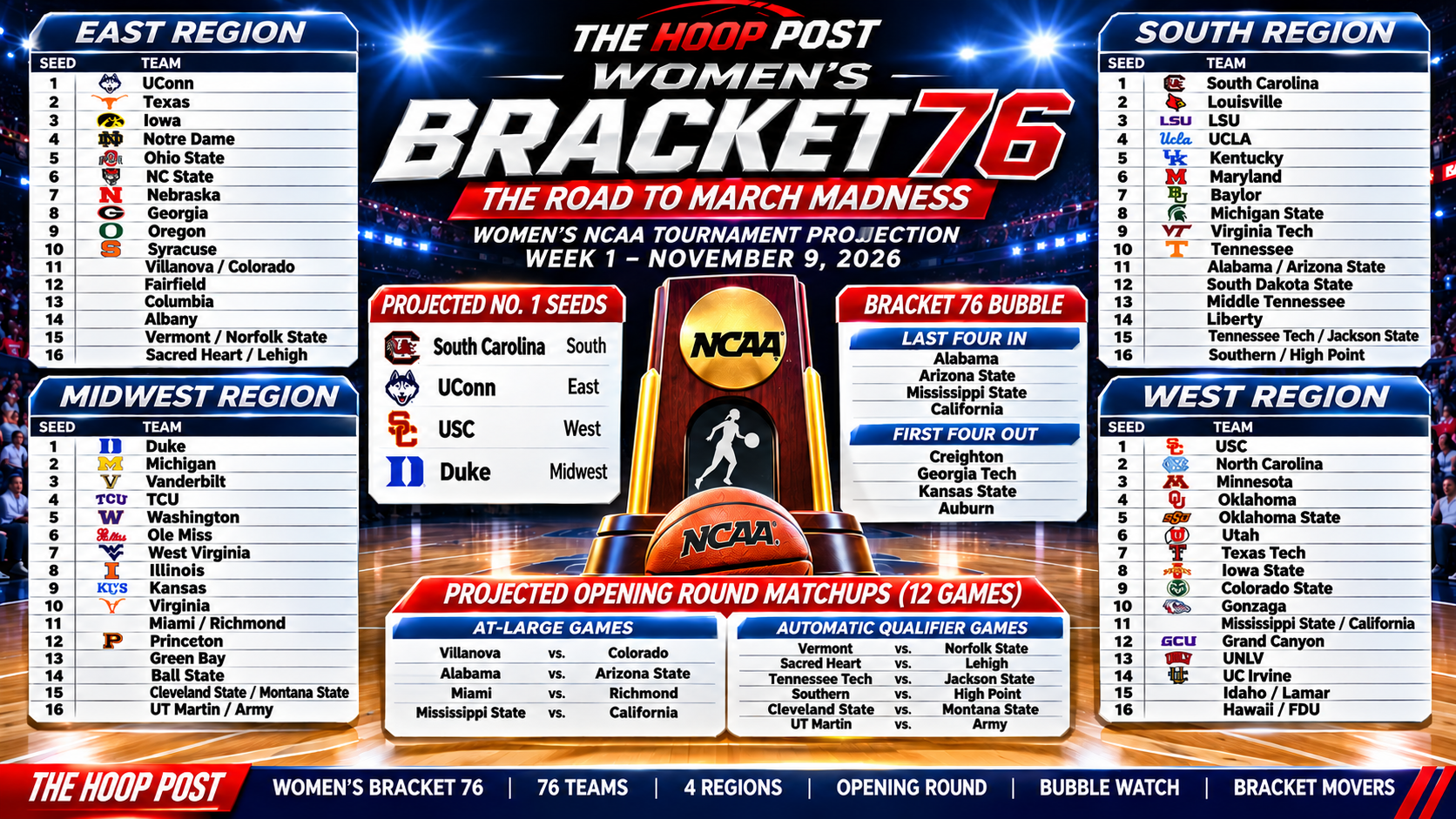
South Carolina, UConn, USC and Duke lead the opening women’s 76-team field, while Michigan, Texas and defending national champion UCLA have opportunities to challenge the early favorites.
The road to the 2027 NCAA Women’s Basketball Tournament is underway, and the expanded 76-team field brings a different dimension to March Madness.
For years, women’s college basketball has been dominated by a collection of established programs. South Carolina, UConn and several other national powers have consistently set the standard. However, the growing depth of the women’s game is creating a more competitive tournament picture.
The addition of eight tournament berths provides more opportunities for programs outside the traditional power conferences. It also makes the selection process more interesting, particularly for teams competing for the final at-large invitations.
In The Hoop Post’s inaugural Women’s Bracket 76, South Carolina earns the No. 1 overall seed, followed by UConn, USC and Duke.
South Carolina enters with the strongest overall projection, but I wouldn’t automatically pencil the Gamecocks into the national championship game. UConn has the experience of playing under championship expectations, USC has the talent to challenge anybody, and Duke is developing into a legitimate contender.
Michigan and Texas are two other programs that deserve serious attention. Both have the potential to move onto the No. 1 seed line as the season develops.
The biggest question isn’t necessarily which program has the most talent. It’s which team can establish the consistency, defensive discipline and offensive execution needed to survive six games against increasingly difficult competition.
HOW THE HOOP POST BUILDS WOMEN’S BRACKET 76
Our Bracketology Methodology
The Hoop Post’s weekly women’s tournament projections combine team evaluation, projected conference performance and NCAA Tournament selection criteria.
For this opening edition, there is limited regular-season evidence available. Consequently, the emphasis is on projected strength rather than completed tournament résumés.
Five factors shape the bracket:
- Roster Talent and Experience: Returning contributors, transfers, freshmen, leadership and roster depth.
- Guard Play and Offensive Execution: Ball movement, shot creation, decision-making and the ability to execute against defensive pressure.
- Defensive Identity and Rebounding: Perimeter defense, interior protection, defensive versatility and controlling the boards.
- Conference Strength and Schedule: Opportunities to earn quality victories and develop a strong tournament résumé.
- The Hoop Post Eye Test: How a team’s personnel, playing style and execution could translate against NCAA Tournament competition.
As the season progresses, actual results, NET rankings, quality victories, strength of schedule and performance away from home will become increasingly important.
Editor’s Note: This is The Hoop Post’s opening women’s tournament projection for the 2026–27 season, covering November 2–8. The field represents an independent forecast, not an official NCAA bracket. Projected automatic qualifiers are preliminary selections, and opening-round pairings are illustrative rather than official NCAA assignments.
THE FIELD OF 76
EAST REGION
No. 1 Seed: UConn
| Seed | Projected Team |
| 1 | UConn |
| 2 | Texas |
| 3 | Iowa |
| 4 | Notre Dame |
| 5 | Ohio State |
| 6 | NC State |
| 7 | Nebraska |
| 8 | Georgia |
| 9 | Oregon |
| 10 | Syracuse |
| 11 | Villanova / Colorado |
| 12 | Fairfield |
| 13 | Columbia |
| 14 | Albany |
| 15 | Vermont / Norfolk State |
| 16 | Sacred Heart / Lehigh |
The Hoop Post Perspective
UConn enters as the No. 1 seed in the East, but the Huskies will have to demonstrate that their offensive execution can remain dependable against the nation’s strongest defensive teams.
What separates UConn from many programs is its ability to develop players who understand spacing, ball movement and how to create scoring opportunities without depending entirely on individual matchups.
However, I want to see how the Huskies respond when opponents apply physical pressure, disrupt passing lanes and force them to generate offense late in the shot clock.
Texas could present the biggest challenge in this region.
The Longhorns have the athleticism and defensive potential to make life difficult for opponents. Their ability to pressure ball handlers, compete on the glass and generate transition opportunities could become a major advantage.
Iowa is another program worth watching. The Hawkeyes have an opportunity to establish themselves among the strongest teams in the Big Ten, but their defensive consistency will be particularly important.
Notre Dame is my most interesting team in this region.
The Fighting Irish have the potential to outperform a No. 4 seed, particularly if their guards establish a reliable offensive rhythm and the team can defend without giving opponents repeated second-chance opportunities.
The Hoop Post Regional Sleeper: Notre Dame
SOUTH REGION
No. 1 Seed: South Carolina — No. 1 Overall
| Seed | Projected Team |
| 1 | South Carolina |
| 2 | Louisville |
| 3 | LSU |
| 4 | UCLA |
| 5 | Kentucky |
| 6 | Maryland |
| 7 | Baylor |
| 8 | Michigan State |
| 9 | Virginia Tech |
| 10 | Tennessee |
| 11 | Alabama / Arizona State |
| 12 | South Dakota State |
| 13 | Middle Tennessee |
| 14 | Liberty |
| 15 | Tennessee Tech / Jackson State |
| 16 | Southern / High Point |
The Hoop Post Perspective
South Carolina opens as my No. 1 overall seed because of the standard Dawn Staley has established in Columbia.
The Gamecocks have consistently demonstrated the ability to defend, rebound and compete physically against the country’s strongest programs.
But there are areas I want to evaluate before declaring South Carolina the clear national championship favorite.
The first is offensive execution.
South Carolina must demonstrate that it can generate quality scoring opportunities when opponents take away transition baskets and force the Gamecocks into longer half-court possessions.
The second is perimeter consistency. Against elite tournament opponents, defenses will attempt to limit interior opportunities and make outside shooting a determining factor.
Louisville has the potential to become a serious challenger in this region. The Cardinals’ ability to establish defensive pressure and create balanced scoring could make them particularly dangerous.
LSU is another program I wouldn’t overlook.
Kim Mulkey’s teams have the potential to create problems through physical play and rebounding. However, LSU must establish the offensive discipline necessary to compete against teams capable of controlling the tempo.
Defending national champion UCLA receives a projected No. 4 seed.
I believe the Bruins could outperform that position, but they must establish how their current roster can sustain the level of execution that carried the program to its first national championship.
The Hoop Post Regional Sleeper: UCLA
MIDWEST REGION
No. 1 Seed: Duke
| Seed | Projected Team |
| 1 | Duke |
| 2 | Michigan |
| 3 | Vanderbilt |
| 4 | TCU |
| 5 | Washington |
| 6 | Ole Miss |
| 7 | West Virginia |
| 8 | Illinois |
| 9 | Kansas |
| 10 | Virginia |
| 11 | Miami / Richmond |
| 12 | Princeton |
| 13 | Green Bay |
| 14 | Ball State |
| 15 | Cleveland State / Montana State |
| 16 | UT Martin / Army |
The Hoop Post Perspective
Duke receives the No. 1 seed in the Midwest, but this could become one of the most competitive regions in the tournament.
The Blue Devils enter the season with their highest preseason national ranking in more than a decade.
For me, Duke’s biggest challenge will be proving that its talent can translate into consistent execution against experienced opponents.
The Blue Devils have the opportunity to establish a strong defensive identity, but they must also demonstrate patience offensively.
Against quality defensive teams, possessions become more difficult. Players must recognize mismatches, make the extra pass and avoid forcing shots when the first option isn’t available.
Michigan is the team I would watch most closely.
The Wolverines have the potential to challenge Duke for the region’s top seed. Michigan’s rise in the national picture is significant, but I want to see whether the Wolverines can maintain their offensive efficiency against opponents that defend with greater physicality.
Vanderbilt is another intriguing program.
The Commodores have an opportunity to establish themselves among the SEC’s strongest teams. If their offensive production is accompanied by dependable defense and rebounding, a No. 3 seed could eventually be too low.
TCU also deserves attention.
The Horned Frogs have an opportunity to challenge for the Big 12 championship, and their ability to control possessions could make them a difficult tournament opponent.
The Hoop Post Regional Sleeper: Vanderbilt
WEST REGION
No. 1 Seed: USC
| Seed | Projected Team |
| 1 | USC |
| 2 | North Carolina |
| 3 | Minnesota |
| 4 | Oklahoma |
| 5 | Oklahoma State |
| 6 | Utah |
| 7 | Texas Tech |
| 8 | Iowa State |
| 9 | Colorado State |
| 10 | Gonzaga |
| 11 | Mississippi State / California |
| 12 | Grand Canyon |
| 13 | UNLV |
| 14 | UC Irvine |
| 15 | Idaho / Lamar |
| 16 | Hawaii / FDU |
The Hoop Post Perspective
USC enters as the No. 1 seed in the West, but the Trojans will need to demonstrate that their individual talent can translate into consistent team execution.
USC has the potential to become one of the most difficult teams to defend in the country.
However, the Trojans must establish the right offensive balance. Having talented scorers is important, but championship teams must also recognize defensive adjustments and create opportunities for teammates.
North Carolina could challenge USC if the Tar Heels establish consistent perimeter shooting and improve their ability to finish possessions defensively.
Minnesota is one of my most interesting teams in the West.
The Golden Gophers have an opportunity to build on their growing national profile, but their performance against the Big Ten’s strongest opponents will ultimately determine whether they belong among the top three seed lines.
Oklahoma is another team that could rise quickly.
The Sooners have opportunities to build a strong tournament résumé through SEC competition. However, they must establish defensive consistency and avoid prolonged offensive stretches in which they depend on difficult individual shots.
Grand Canyon is my early Cinderella candidate.
The Antelopes would need to demonstrate that they can compete against stronger opponents, but a program that protects the basketball, controls the tempo and rebounds effectively can become a difficult first-round matchup.
The Hoop Post Regional Sleeper: Grand Canyon
PROJECTED OPENING ROUND
Twelve Games Before the Field of 64
The expanded 76-team tournament includes 12 Opening Round games involving 24 teams.
For this projection, six matchups feature at-large selections and six feature projected automatic qualifiers.
At-Large Opening Round
| Game | Region | Projected Matchup |
| 1 | East | Villanova vs. Colorado |
| 2 | South | Alabama vs. Arizona State |
| 3 | Midwest | Miami vs. Richmond |
| 4 | West | Mississippi State vs. California |
| 5 | East | Additional at-large matchup TBD |
| 6 | South | Additional at-large matchup TBD |
Automatic Qualifier Opening Round
| Game | Region | Projected Matchup |
| 7 | East | Vermont vs. Norfolk State |
| 8 | East | Sacred Heart vs. Lehigh |
| 9 | South | Tennessee Tech vs. Jackson State |
| 10 | South | Southern vs. High Point |
| 11 | Midwest | Cleveland State vs. Montana State |
| 12 | Midwest | UT Martin vs. Army |
Bracket construction note: The West’s Idaho–Lamar and Hawaii–FDU pairings are also provisional opening-round candidates. The exact allocation of automatic-qualifier and at-large pairings remains subject to a completed bracket reconciliation. These matchups should not be treated as an official or finalized NCAA bracket.
The Hoop Post Perspective
The Opening Round could become one of the most interesting developments in women’s college basketball.
The expanded format gives additional programs an opportunity to participate in March Madness, but it also creates a different challenge for teams competing near the tournament cutline.
Arizona State is a team I would watch closely.
The Sun Devils have an opportunity to strengthen their tournament outlook, but they must establish consistency against quality opponents.
Villanova and Colorado are also intriguing possibilities.
Both programs could find themselves in competitive conference races, making the quality of their victories particularly important.
For these teams, the objective shouldn’t simply be reaching the tournament. It’s demonstrating that they can compete once they arrive.
THE BRACKET 76 BUBBLE REPORT
Last Four In — Early Watch List
| Team | Projected Seed | Status |
| Alabama | 11 | Opening Round |
| Arizona State | 11 | Opening Round |
| Mississippi State | 11 | Opening Round |
| California | 11 | Opening Round |
The Hoop Post Perspective
The opening bubble remains difficult to evaluate because teams have not yet established complete tournament résumés.
Arizona State has an opportunity to become one of the more interesting programs to follow in the Big 12.
Alabama and Mississippi State will have opportunities to strengthen their positions through SEC competition, but neither can afford prolonged stretches of inconsistent play.
California faces a similar challenge in the ACC.
Winning games is important, but the quality of those victories will eventually determine whether these programs remain in the field.
First Four Out
| Team | Status |
| Creighton | First Four Out |
| Georgia Tech | First Four Out |
| Kansas State | First Four Out |
| Auburn | First Four Out |
Creighton has the opportunity to establish itself as a tournament contender through Big East competition.
Georgia Tech and Kansas State must demonstrate that they can consistently compete against stronger conference opponents.
Auburn will have opportunities to build a résumé in the SEC, but the Tigers must turn those opportunities into meaningful victories.
Next Four Out
| Team | Status |
| Florida State | Outside Looking In |
| BYU | Outside Looking In |
| Arizona | Outside Looking In |
| Seton Hall | Outside Looking In |
These programs remain within reach of the projected field, but they need to establish stronger tournament cases as the season progresses.
THE HOOP POST EYE TEST
Three Teams That Could Change the Bracket
1. Michigan — A Potential No. 1 Seed
Michigan enters Bracket 76 as a No. 2 seed, but I believe the Wolverines have an opportunity to challenge for a top seed.
What interests me about Michigan is the program’s potential to establish itself among the Big Ten’s elite.
However, Michigan must demonstrate that it can execute offensively when opponents apply physical pressure and limit transition opportunities.
The Wolverines also need to establish dependable defensive rebounding.
Against elite teams, giving up second-chance opportunities can become the difference between winning and losing.
My assessment: Michigan has No. 1 seed potential, but I want to see how the Wolverines perform against the strongest teams on their schedule before moving them higher.
2. UCLA — Don’t Overlook the Defending Champions
UCLA opens as a No. 4 seed, but I wouldn’t be surprised if the Bruins move considerably higher.
Winning a national championship establishes expectations, but it doesn’t guarantee the following season will produce the same results.
The Bruins must demonstrate that their current roster can establish its own identity.
What I want to see is whether UCLA can maintain its defensive discipline, control the boards and generate dependable offense against quality opponents.
The program has demonstrated that it can compete at the highest level. The challenge now is maintaining that standard.
My assessment: UCLA could move into the top two seed lines, but its current personnel must establish that it can sustain championship-level execution.
3. Grand Canyon — My Early Cinderella Candidate
Grand Canyon enters the opening projection as a No. 12 seed.
The Antelopes interest me because mid-major programs can become dangerous when they establish a consistent playing style.
Grand Canyon doesn’t necessarily need to match a national power in individual talent.
It needs to defend effectively, limit turnovers and avoid giving opponents repeated scoring opportunities.
The biggest question will be whether the Antelopes can generate enough offense against teams with greater size and athleticism.
My assessment: Grand Canyon has the potential to become a first-round upset candidate, but its ability to compete against stronger opponents must be established during the regular season.
BIGGEST MOVERS TO WATCH
Five Teams That Could Rise Before December
This opening edition establishes the starting point for Women’s Bracket 76.
Beginning next week, this section will track actual movement in the projected tournament field.
For now, these are five programs with opportunities to improve their seed positions.
| Team | Current Seed | Potential Seed | Key to Moving Up |
| Michigan | 2 | 1 | Consistency against elite competition |
| UCLA | 4 | 2 | Roster chemistry and offensive execution |
| Vanderbilt | 3 | 2 | Defensive consistency |
| Minnesota | 3 | 2 | Quality wins against Big Ten opponents |
| Grand Canyon | 12 | 10 | Strong nonconference performances |
Michigan
Michigan has the opportunity to establish itself among the nation’s best teams.
The Wolverines could challenge for a No. 1 seed if they demonstrate that their offense can remain effective against elite defensive competition.
UCLA
The Bruins have the potential to make one of the biggest jumps in the bracket.
If UCLA establishes dependable guard play, defensive consistency and strong rebounding, its projected No. 4 seed could change quickly.
Vanderbilt
Vanderbilt is a program I believe deserves close attention.
The Commodores could challenge for a No. 2 seed if they establish consistency against the SEC’s strongest opponents.
Minnesota
Minnesota has an opportunity to strengthen its national profile.
However, the Golden Gophers must demonstrate that they can maintain their execution against teams capable of applying pressure defensively.
Grand Canyon
Grand Canyon could improve its position by demonstrating that it can compete outside its conference.
A move toward the No. 10 seed line would represent a significant improvement and could make the Antelopes a team to watch entering March.
A TEAM I NEED TO SEE MORE FROM
USC
USC receives a projected No. 1 seed in the West, but I am not ready to move the Trojans ahead of South Carolina or UConn.
The Trojans have the potential to become a national championship contender, but they must demonstrate that their offensive talent can translate into dependable team execution.
I want to see how USC responds when opponents apply defensive pressure and take away its preferred scoring opportunities.
The Trojans must also establish consistency on the defensive end.
Against elite competition, offensive talent alone won’t be enough.
USC belongs among the early contenders, but its ability to execute against physical opponents will determine whether it can remain on the No. 1 seed line.
THE HOOP POST FINAL FOUR PROJECTION
| Region | Projected Champion |
| East | UConn |
| South | South Carolina |
| Midwest | Duke |
| West | USC |
Projected National Championship
South Carolina vs. UConn
Early National Championship Pick
South Carolina
South Carolina enters the season as my projected national champion.
The Gamecocks have established a program built around defense, rebounding and physical play. Those characteristics become particularly valuable in the NCAA Tournament.
However, UConn has the ability to challenge South Carolina because of its offensive execution and experience competing under championship expectations.
Duke, USC, Michigan, Texas and UCLA also deserve consideration as potential Final Four contenders.
These projections will change as the season progresses and teams establish stronger tournament résumés.
THE FINAL WORD
The Road to the 2027 Women’s Final Four Begins
The first edition of Women’s Bracket 76 provides an early look at what could become one of the most competitive NCAA Women’s Basketball Tournaments in recent years.
South Carolina begins as the No. 1 overall seed, but UConn, USC and Duke have opportunities to challenge the Gamecocks.
Michigan, Texas and UCLA are also capable of changing the tournament picture.
The expanded field provides more opportunities, particularly for programs that have traditionally found themselves outside the tournament.
However, additional invitations don’t necessarily make winning a national championship easier.
Teams still must defend, rebound, execute offensively and develop the chemistry necessary to compete against the nation’s strongest opponents.
For me, the most interesting part of the season will be identifying which programs are improving before the national rankings fully reflect their development.
Some teams will begin the season with considerable attention but struggle once conference competition becomes more demanding.
Others will develop gradually, establish a consistent identity and become dangerous when March arrives.
That’s what The Hoop Post’s Women’s Bracket 76 will examine throughout the season.
Not simply which teams are projected to make the NCAA Tournament, but which programs are developing into legitimate championship contenders.
Women’s Bracket 76 returns with updated regional projections, Opening Round matchups, bubble analysis and the first Biggest Movers report.
Women’s Bracket 76 | The Hoop Post | Road to March Madness 2027
Independent women’s NCAA Tournament projections and basketball analysis.