College basketball wasted little time reminding everyone that preseason expectations don’t always translate into results on the court.
The opening week produced several performances that deserve attention, including Florida’s victory over Miami, UCLA’s upset of Arizona and Virginia’s convincing win over Arkansas. While one week won’t determine where teams will be seeded in March, it provides an early indication of which programs are prepared to compete against quality opponents.
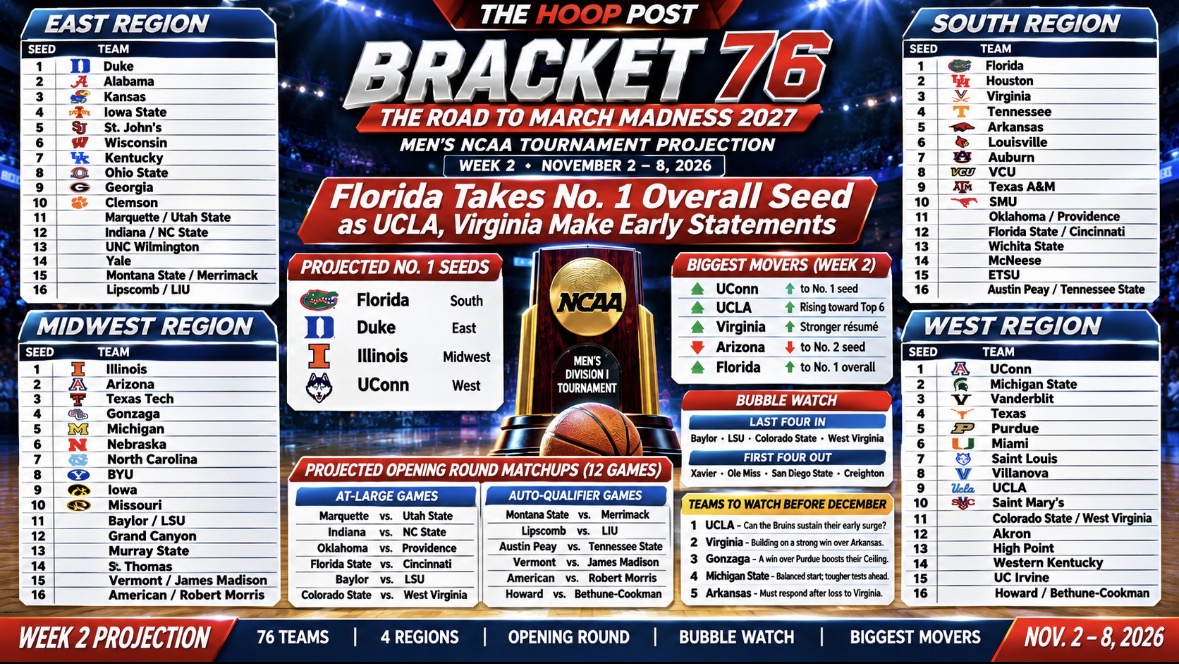
In the second edition of The Hoop Post’s Bracket 76, Florida moves ahead of Duke for the No. 1 overall seed. Illinois remains on the top line, while UConn replaces Arizona as the fourth projected No. 1 seed.
Arizona falls to a No. 2 seed after losing to UCLA, while the Bruins move up following one of the opening week’s most impressive victories.
Virginia also makes a significant move after defeating Arkansas, showing the kind of offensive execution and defensive discipline that could make the Cavaliers a serious contender.
The biggest takeaway from the opening week isn’t simply which teams won or lost. It’s how they performed against the competition.
Some programs showed balance, depth and the ability to make adjustments. Others demonstrated that individual talent won’t always be enough to overcome poor execution.
That’s what Bracket 76 will continue to examine throughout the season.
HOW THE HOOP POST BUILDS BRACKET 76
Bracketology Methodology
Bracket 76 combines tournament résumé evaluation with basketball scouting and team performance.
Five factors influence the weekly projections:
- Quality Wins and Strength of Schedule: Performance against nationally competitive opponents, including neutral-site and road games.
- Offensive Execution: Guard play, shot selection, ball movement, turnovers and the ability to score in the half court.
- Defensive Identity: Defensive pressure, rebounding, interior protection and the ability to limit opponents’ preferred scoring opportunities.
- Roster Development: Contributions from returning players, freshmen and transfers, along with overall team chemistry.
- The Hoop Post Eye Test: How a team performs beyond the final score and whether its style can translate against tournament-caliber opponents.
As the season progresses, NET rankings, quality wins, schedule strength and performance in conference play will become increasingly important.
Editor’s Note: These are independent projections of the 2027 NCAA Tournament field. Early-season results are beginning to influence the bracket, but the selections still reflect a substantial amount of projected team strength. Seedings and matchups are subject to change.
THE FIELD OF 76
EAST REGION
No. 1 Seed: Duke
| Seed | Projected Team |
| 1 | Duke |
| 2 | Alabama |
| 3 | Kansas |
| 4 | Iowa State |
| 5 | St. John’s |
| 6 | Wisconsin |
| 7 | Kentucky |
| 8 | Ohio State |
| 9 | Georgia |
| 10 | Clemson |
| 11 | Marquette / Utah State |
| 12 | Indiana / NC State |
| 13 | UNC Wilmington |
| 14 | Yale |
| 15 | Montana State / Merrimack |
| 16 | Lipscomb / LIU |
The Hoop Post Perspective
Duke remains a No. 1 seed, but the Blue Devils no longer hold the top overall position.
Their 84–50 victory over Army was impressive, particularly because of the way they controlled the paint and pressured the basketball.
Duke scored 50 points inside and forced 24 turnovers, demonstrating an ability to create offense through defensive activity rather than depending entirely on perimeter shooting.
Dame Sarr scored 16 points, while freshman Joaquim Boumtje Boumtje contributed 15 points, seven rebounds and three blocked shots.
Those are encouraging signs for a team with championship expectations.
However, Army isn’t the type of opponent that will determine Duke’s postseason ceiling. I want to see whether the Blue Devils can create the same defensive pressure against experienced guards and teams with multiple scoring options.
Duke has the talent to regain the No. 1 overall seed, but Florida’s performance against Miami gives the Gators the early advantage.
St. John’s remains one of my teams to watch.
The Red Storm opened with a victory over Monmouth, but their projected No. 5 seed remains largely unchanged. St. John’s needs to demonstrate that its offensive production can match its defensive potential against stronger opponents.
Regional Sleeper: St. John’s
SOUTH REGION
No. 1 Seed: Florida
| Seed | Projected Team |
| 1 | Florida |
| 2 | Houston |
| 3 | Virginia |
| 4 | Tennessee |
| 5 | Arkansas |
| 6 | Louisville |
| 7 | Auburn |
| 8 | VCU |
| 9 | Texas A&M |
| 10 | SMU |
| 11 | Oklahoma / Providence |
| 12 | Florida State / Cincinnati |
| 13 | Wichita State |
| 14 | McNeese |
| 15 | ETSU |
| 16 | Austin Peay / Tennessee State |
The Hoop Post Perspective
Florida earns the No. 1 overall seed after opening the season with a 77–67 victory over Miami.
The Gators showed why they belong among the nation’s leading championship contenders.
Thomas Haugh delivered 19 points and 10 rebounds, providing the type of production Florida needs from its experienced players. Rueben Chinyelu contributed 14 rebounds, helping the Gators establish a physical presence inside.
What impressed me most wasn’t simply Florida’s ability to score. It was how the Gators responded when Miami threatened to take control.
Miami cut the deficit to two points in the second half, but Florida answered defensively and regained separation.
That’s the kind of response I look for when evaluating potential No. 1 seeds.
The Gators weren’t perfect, particularly at the free-throw line, but they showed composure against a nationally ranked opponent.
Virginia is another team that made a statement.
The Cavaliers’ 91–72 victory over Arkansas deserves more attention than a routine early-season win.
Virginia established control early and demonstrated that it could produce offensively while limiting a talented opponent.
Arkansas entered with considerable expectations, but the Razorbacks struggled to respond once Virginia established its advantage.
The result strengthens Virginia’s position on the No. 3 seed line and raises questions about whether Arkansas deserves its projected No. 5 seed.
Houston remains a serious challenger in this region, but Florida has earned the early advantage.
Regional Sleeper: Louisville
MIDWEST REGION
No. 1 Seed: Illinois
| Seed | Projected Team |
| 1 | Illinois |
| 2 | Arizona |
| 3 | Texas Tech |
| 4 | Gonzaga |
| 5 | Michigan |
| 6 | Nebraska |
| 7 | North Carolina |
| 8 | BYU |
| 9 | Iowa |
| 10 | Missouri |
| 11 | Baylor / LSU |
| 12 | Grand Canyon |
| 13 | Murray State |
| 14 | St. Thomas |
| 15 | Vermont / James Madison |
| 16 | American / Robert Morris |
The Hoop Post Perspective
Illinois remains a No. 1 seed after opening the season with a dominant 120–45 victory over Fairleigh Dickinson.
The Fighting Illini made 19 three-pointers and placed six players in double figures.
Andrej Stojakovic and Stefan Vaaks each scored 20 points, while Illinois controlled the rebounding battle 65–21.
The performance showed the Fighting Illini’s offensive potential, particularly their ability to generate scoring from multiple positions.
However, I wouldn’t place too much emphasis on the margin of victory.
Illinois must demonstrate that it can maintain that level of execution against stronger defensive opponents.
The Fighting Illini belong on the No. 1 seed line, but their next challenge will be proving that their offensive production isn’t dependent on favorable matchups.
Arizona moves into this region as a No. 2 seed.
The Wildcats’ loss to UCLA exposed some early concerns.
Ivan Kharchenkov scored 38 points, but Arizona received limited production from the rest of its roster.
That imbalance is concerning for a program with national championship expectations.
Arizona needs more consistent scoring from its supporting players. Opponents will eventually force the Wildcats to find offense beyond one individual performance.
Gonzaga also deserves attention following its opening victory over Purdue. The Bulldogs demonstrated that they can compete against a quality opponent, strengthening their position as a dangerous No. 4 seed.
Regional Sleeper: Grand Canyon
WEST REGION
No. 1 Seed: UConn
| Seed | Projected Team |
| 1 | UConn |
| 2 | Michigan State |
| 3 | Vanderbilt |
| 4 | Texas |
| 5 | Purdue |
| 6 | Miami |
| 7 | Saint Louis |
| 8 | Villanova |
| 9 | UCLA |
| 10 | Saint Mary’s |
| 11 | Colorado State / West Virginia |
| 12 | Akron |
| 13 | High Point |
| 14 | Western Kentucky |
| 15 | UC Irvine |
| 16 | Howard / Bethune-Cookman |
The Hoop Post Perspective
UConn moves onto the No. 1 seed line after an encouraging opening week.
The Huskies began with an 86–46 victory over Gardner-Webb before defeating Michigan 85–77.
The Michigan victory carries considerably more weight.
Braylon Mullins and Silas Demary Jr. combined for 44 points against the Wolverines, giving UConn the offensive production it needed in a competitive matchup.
What stands out about UConn is its ability to execute when the game becomes more demanding.
The Huskies have shown early signs of offensive balance and the ability to make plays against quality competition.
UConn still has work to do, but its early performance gives it an advantage over Arizona for the fourth No. 1 seed.
UCLA is the team that deserves the most attention in this region.
The Bruins defeated Arizona 84–75 behind 21 points from Trent Perry.
More importantly, UCLA received contributions from several players and maintained its composure when Arizona attempted to rally.
The Bruins led by as many as 16 points before the Wildcats reduced the deficit to one late in the game.
UCLA responded and secured the victory.
That performance suggests the Bruins may be considerably better than their original No. 9 seed projection.
Michigan State also opened with an impressive victory over Quinnipiac, with Jeremy Fears Jr. contributing 13 points and 11 assists.
The Spartans remain on the No. 2 line, but their ability to maintain balanced scoring against stronger competition will be important.
Regional Sleeper: UCLA
PROJECTED OPENING ROUND
Twelve Games Before the Field of 64
The expanded tournament creates six additional Opening Round games compared with the previous 68-team format.
Bracket 76 projects six matchups between at-large teams and six between automatic qualifiers.
At-Large Opening Round
| Game | Region | Projected Matchup |
| 1 | East | Marquette vs. Utah State |
| 2 | East | Indiana vs. NC State |
| 3 | South | Oklahoma vs. Providence |
| 4 | South | Florida State vs. Cincinnati |
| 5 | Midwest | Baylor vs. LSU |
| 6 | West | Colorado State vs. West Virginia |
Automatic Qualifier Opening Round
| Game | Region | Projected Matchup |
| 7 | East | Montana State vs. Merrimack |
| 8 | East | Lipscomb vs. LIU |
| 9 | South | Austin Peay vs. Tennessee State |
| 10 | Midwest | Vermont vs. James Madison |
| 11 | Midwest | American vs. Robert Morris |
| 12 | West | Howard vs. Bethune-Cookman |
The Hoop Post Perspective
The expanded Opening Round could create additional challenges for teams that struggle with consistency.
For programs competing near the tournament bubble, receiving an invitation may not guarantee a favorable matchup.
Baylor against LSU remains one of the more interesting projected games.
Both programs would enter with something to prove, and the ability to control turnovers and execute offensively could determine which team advances.
Indiana against NC State is another potential matchup worth watching.
The Opening Round will reward teams that are prepared to compete immediately rather than rely on their regular-season reputations.
THE BRACKET 76 BUBBLE REPORT
Last Four In
| Team | Projected Seed | Status |
| Baylor | 11 | Opening Round |
| LSU | 11 | Opening Round |
| Colorado State | 11 | Opening Round |
| West Virginia | 11 | Opening Round |
The Hoop Post Perspective
The tournament bubble remains difficult to evaluate after only one week.
Baylor, LSU, Colorado State and West Virginia remain the final four teams in the projected field.
However, their positions should not be considered secure.
As more games are played, these programs will need to demonstrate that they can compete against tournament-caliber opponents.
The expanded field provides additional opportunities, but it won’t eliminate the importance of quality victories.
First Four Out
| Team | Status |
| Xavier | First Four Out |
| Ole Miss | First Four Out |
| San Diego State | First Four Out |
| Creighton | First Four Out |
These four programs remain close to the projected field.
For Xavier and Creighton, Big East competition will provide opportunities to strengthen their résumés.
Ole Miss must take advantage of opportunities against quality SEC opponents, while San Diego State will need to establish consistency.
Next Four Out
| Team | Status |
| Wake Forest | Outside Looking In |
| Boise State | Outside Looking In |
| UCF | Outside Looking In |
| New Mexico | Outside Looking In |
THE HOOP POST EYE TEST
Three Teams That Changed My Perspective
1. UCLA — Better Than Its Projected Seed
UCLA may have delivered the most important victory of the opening week.
The Bruins defeated Arizona 84–75, but the result tells only part of the story.
What stood out was UCLA’s ability to generate offense from multiple players while maintaining its defensive approach against a talented opponent.
Trent Perry scored 21 points, but the Bruins didn’t depend entirely on one player.
Arizona received 38 points from Ivan Kharchenkov and still couldn’t overcome UCLA.
That difference matters.
Teams with balanced scoring options can become difficult to defend because opponents can’t focus on taking away one individual.
UCLA also showed composure when Arizona attempted to rally.
The Bruins remain a No. 9 seed in this projection, but that position could change quickly.
My assessment: UCLA has already demonstrated the potential to become a top-six seed. I want to see whether the Bruins can sustain that level of execution.
2. Virginia — A Team That Deserves More Attention
Virginia’s 91–72 victory over Arkansas was one of the opening week’s strongest statements.
The Cavaliers didn’t simply defeat a talented opponent. They established control early and maintained their advantage.
That is significant because Arkansas entered the season with expectations of competing near the top of the SEC.
Virginia showed that it could execute offensively while preventing the Razorbacks from establishing a rhythm.
The Cavaliers remain a No. 3 seed, but their performance suggests they could challenge for a higher position.
My assessment: Virginia belongs in the conversation among the nation’s strongest teams. The Cavaliers must now demonstrate that their performance against Arkansas wasn’t an isolated result.
3. Arizona — A Team I Need to See More From
Arizona’s loss to UCLA raises an important question.
Can the Wildcats generate enough balanced scoring against strong defensive opponents?
Ivan Kharchenkov’s 38-point performance was impressive, but Arizona couldn’t overcome UCLA’s more balanced offensive production.
That is concerning for a team that entered the season as a projected No. 1 seed.
The Wildcats have enough talent to recover, but they must establish additional scoring options and improve their ability to execute when opponents control the tempo.
My assessment: Arizona remains a national contender, but I am moving the Wildcats to the No. 2 seed line until they demonstrate greater offensive balance.
BIGGEST MOVERS
Five Teams Making an Early Statement
| Team | Week 1 | Week 2 | Movement |
| UConn | No. 2 | No. 1 | ↑ 1 seed line |
| Virginia | No. 3 | No. 3 | Holding; résumé strengthened |
| UCLA | No. 9 | No. 9 | Holding; significant upside |
| Arizona | No. 1 | No. 2 | ↓ 1 seed line |
| Florida | No. 1 | No. 1 | ↑ To No. 1 overall |
Florida — Moving to the Top
Florida’s victory over Miami gives the Gators the strongest early case for the No. 1 overall seed.
The combination of Thomas Haugh’s production, interior rebounding and defensive execution was enough to move Florida ahead of Duke.
UConn — Moving Into the Top Four
UConn’s victory over Michigan strengthens the Huskies’ position.
The ability to execute against a quality opponent gives UConn an early advantage over Arizona.
UCLA — A Bigger Move Could Be Coming
UCLA remains on the No. 9 seed line, but that position may be temporary.
The Bruins’ victory over Arizona suggests they could climb considerably if they continue to demonstrate balanced scoring and defensive discipline.
Arizona — An Early Step Backward
Arizona drops from a No. 1 seed to a No. 2 seed.
The Wildcats remain talented, but their offensive imbalance against UCLA raises questions that must be addressed.
Virginia — Building a Stronger Case
Virginia remains a No. 3 seed, but its victory over Arkansas strengthens its position.
The Cavaliers have an opportunity to challenge for a No. 2 seed if they continue to perform at that level.
FIVE TEAMS TO WATCH BEFORE DECEMBER
1. UCLA: The Bruins have already demonstrated that they can defeat a highly regarded opponent. Their next challenge is maintaining that level of execution.
2. Virginia: The Cavaliers have an opportunity to build momentum following their convincing victory over Arkansas.
3. Gonzaga: The Bulldogs’ victory over Purdue strengthens their early tournament outlook. Their ability to execute against quality opponents could push them higher.
4. Michigan State: The Spartans opened with balanced scoring and strong guard play. They must now demonstrate those strengths against tougher competition.
5. Arkansas: The Razorbacks must respond after their loss to Virginia. Defensive improvement and more balanced offense will be important.
THE HOOP POST FINAL FOUR PROJECTION
| Region | Projected Champion |
| East | Duke |
| South | Florida |
| Midwest | Illinois |
| West | UConn |
Projected National Championship
Duke vs. Florida
Early National Championship Pick
Florida
Florida moves ahead of Duke as The Hoop Post’s early championship selection.
The Gators demonstrated the ability to respond when challenged against Miami, while their interior presence and experienced personnel provide an encouraging foundation.
Duke remains a serious contender, but the Blue Devils must show that their defensive pressure and offensive execution can translate against stronger opponents.
Illinois and UConn also belong in the championship conversation.
Arizona remains capable of returning to the top seed line, but the Wildcats must address the offensive concerns exposed by UCLA.
THE FINAL WORD
Early Results Are Beginning to Shape the Road to March
The first week of college basketball provided an early reminder that preseason expectations are only a starting point.
Florida moves into the No. 1 overall position, Duke remains among the championship favorites, and UConn joins the top seed line.
UCLA and Virginia made strong opening statements, while Arizona and Arkansas have questions to answer.
The biggest challenge moving forward will be separating teams that simply look impressive against weaker opponents from programs capable of competing consistently against tournament-caliber competition.
One week won’t determine the NCAA Tournament field.
But it can reveal which teams are prepared, which programs need improvement and which players could change their team’s postseason outlook.
That’s what Bracket 76 will continue to examine.
Not just who’s in the tournament, but which teams are building toward something bigger.
Bracket 76 returns next Monday with updated regional projections, Opening Round matchups, bubble analysis and the latest Biggest Movers report.
Bracket 76 | The Hoop Post | Road to March Madness 2027
Independent tournament projections and basketball analysis.