The Phoenix Suns may have gotten a glimpse of something special this summer.
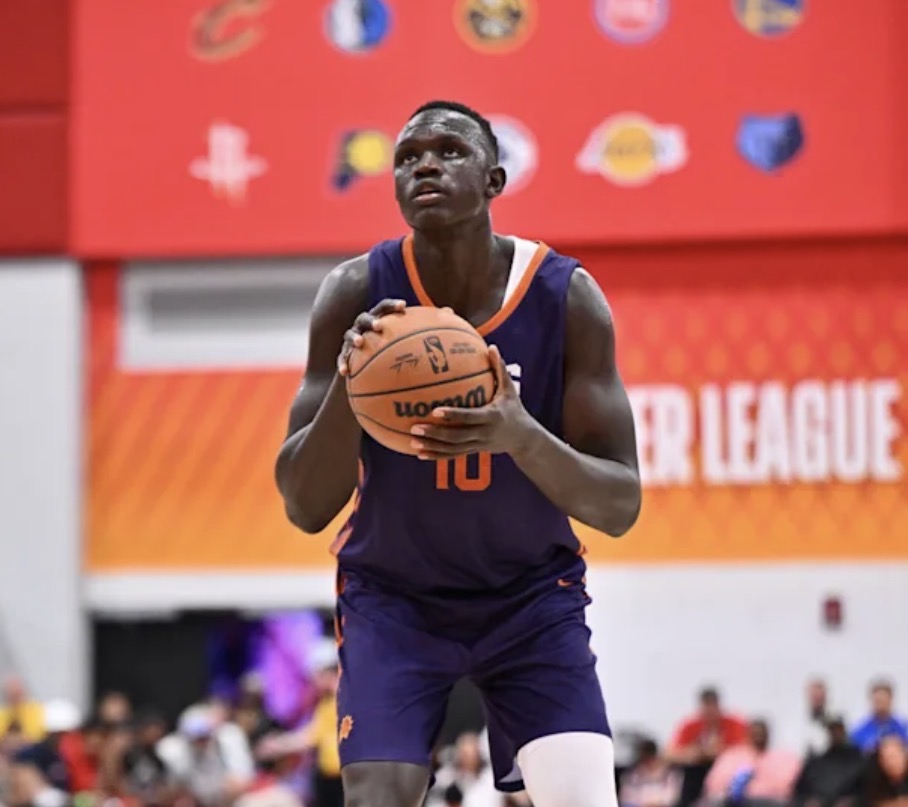
Khaman Maluach entered the 2026 Summer League looking to build on his first season in the NBA. What followed was four games that provided Phoenix with plenty of encouragement about what the young center could bring to the team during the 2026-27 season.
Maluach wasn’t simply productive. He looked stronger, more aggressive and increasingly comfortable on both ends of the floor.
In four games, the 19-year-old averaged 19.5 points, 12.8 rebounds, 2.0 blocks and 1.3 steals per game, while shooting 53.2% from the field and an impressive 40% from three-point range. He also recorded a double-double in every game. Those numbers immediately grab attention, but the bigger story is how Maluach produced them.
Maluach Looked Like a Different Player
The most encouraging part of Maluach’s Summer League performance wasn’t necessarily his scoring. It was his confidence. The young big man appeared more comfortable attacking the basket, running the floor, battling for rebounds and finishing through contact. He also appeared more decisive with the basketball, making quicker decisions rather than hesitating.
That type of growth is exactly what Phoenix needed to see. After spending his first season adjusting to the speed, physicality and demands of professional basketball, Maluach appeared to have taken another step forward. His physical development was noticeable as well.
Maluach looked stronger around the basket and more capable of establishing position. His size and length have always been obvious, but strength is what can allow those physical gifts to become consistent advantages against NBA competition. And that may be one of the most important developments of his summer.
Four Games, Four Double-Doubles
Maluach’s consistency was particularly impressive. Against Portland, he finished with 19 points and 11 rebounds, adding two steals and a block. Against New Orleans, he followed with 15 points and 15 rebounds, showing that he could dominate the glass even when his scoring wasn’t at its highest level.
Then came his performance against Milwaukee, when Maluach produced 21 points, 10 rebounds, four blocks and a steal. He finished his Summer League run against Detroit with perhaps his most impressive offensive performance, recording 23 points and 15 rebounds while also knocking down two of his five three-point attempts.
That final game demonstrated why his development could become so intriguing for Phoenix. Maluach wasn’t simply scoring around the rim. He was showing confidence stepping outside and shooting from distance.
The Three-Point Shot Could Change His Ceiling
For a player with Maluach’s size and defensive potential, a reliable three-point shot could dramatically increase his value.
Nobody should assume that four Summer League games prove he is suddenly a 40% NBA three-point shooter. They don’t.
But
But the willingness to shoot matters. So does the confidence. Maluach didn’t appear afraid to take open looks from beyond the arc. If that confidence continues into preseason and eventually translates into respectable regular-season shooting, Phoenix could have another dimension to his game.
A center who can protect the rim on one end and stretch the defense on the other is extremely valuable in today’s NBA. And Maluach has the physical tools to become exactly that type of player.
His Defensive Potential Remains His Calling Card
Offensively, Maluach’s progress was encouraging. Defensively, his potential may be even more important. His length gives him the ability to affect shots without always needing to leave his feet. When he does challenge at the rim, his size can make opposing players think twice before attacking.
His four-block performance against Milwaukee was a reminder of what he can bring defensively. But the next stage of his development will be learning how to consistently use that size without getting into foul trouble.
NBA teams will challenge him differently during the regular season. Guards will attempt to pull him away from the basket.
Veteran big men will test his strength. Offenses will attack him through pick-and-rolls. How Maluach responds to those challenges will determine how quickly Phoenix can trust him with meaningful minutes.
Phoenix May Have More Than a Developmental Project
There is an important distinction when discussing Maluach heading into his second season. The question isn’t whether he is ready to become a star. He doesn’t need to be. The question is whether he can become a reliable rotation player.
His Summer League performance suggests that possibility is becoming increasingly realistic. Maluach doesn’t have to average 20 points during the regular season to be valuable.
If he can give Phoenix quality defense, rebounding, rim protection, screening and efficient finishing, he can impact games without needing plays called for him.
And if the three-point shooting becomes legitimate, his offensive value could increase considerably.
The Plus-Minus Number Is Also Interesting
One statistic that shouldn’t be overlooked is Phoenix’s plus-minus with Maluach on the floor. The Suns were plus-48 during his 109 Summer League minutes.
Plus-minus isn’t a perfect measurement, particularly over a small sample, but it adds another interesting piece to the picture. Maluach wasn’t simply collecting impressive individual statistics. His team was also performing well while he was on the floor.
That’s ultimately what Phoenix needs from him. The goal isn’t to create another player who can accumulate numbers. The goal is to develop a player who helps the Suns win.
The Suns Shut Him Down After Four Games
Phoenix also decided not to continue playing Maluach after his first four Summer League games. That decision was noteworthy. The Suns had already seen enough to evaluate his summer progress, and there was little reason to expose him to additional Summer League minutes if they felt his development objectives had been accomplished.
For Maluach, the message was simple: go home, continue working and prepare for the real challenge. The regular season is where his development will truly be measured.
Five Questions That Will Define His Second Season
The preseason should give Phoenix a better idea of how ready Maluach is for a larger role.
There are five areas worth watching closely.
First, the three-point shot. If Maluach continues shooting confidently from outside, his offensive ceiling becomes much more interesting.
Second, foul trouble. He needs to learn how to use his length and physicality without constantly putting himself in difficult situations.
Third, pick-and-roll defense. Can he protect the rim while still handling guards and recovering when opponents attack him away from the basket?
Fourth, offensive rebounding. His size and length could make him a major second-chance threat.
And fifth, playing time. This may ultimately be the most important factor. Summer League success means very little if Maluach isn’t trusted during the regular season.
If Phoenix believes he is ready, he needs enough minutes to develop rhythm and confidence.
A 19-Year-Old With Plenty of Room to Grow
It’s important to keep perspective. Maluach was only 19 years old as of July 2026. He’s still extremely young for an NBA center. He doesn’t need to have everything figured out yet. What Phoenix needs to see is continued improvement.
The Summer League provided plenty of evidence that improvement is happening.
He looked stronger, he looked more confident and he rebounded aggressively,
He protected the rim, ran the floor and finished through contact.
And he showed an outside shot that could eventually become another important part of his offensive game.
A Summer Worth Celebrating, But Not Overhyping
Maluach’s 2026 Summer League should be viewed as a major success. I’d give him a 9 out of 10. But there is still a difference between dominating Summer League and succeeding against NBA starters during an 82-game season.
The real test begins when Phoenix faces veteran players who will attack his weaknesses and force him to make difficult decisions. That’s why the next step is so important.
Maluach needs to take everything he learned this summer and carry it into training camp and preseason.
If he does, the Suns could have a legitimate young interior presence developing right in front of them.
The Future Could Be Arriving Sooner Than Expected
Phoenix doesn’t need Khaman Maluach to become a superstar immediately. The Suns need him to become dependable. If he can consistently rebound, protect the rim, defend without fouling, run the floor, finish around the basket and knock down open three-pointers, his value could become significant.
And if his confidence continues to grow, his minutes should follow. I wouldn’t be surprised if Maluach eventually pushes toward 20-plus minutes per game during the 2026-27 season if he earns the coaching staff’s trust. The Summer League didn’t guarantee that outcome. But it certainly made it easier to imagine.
For the Phoenix Suns, that’s the most encouraging part of all. Khaman Maluach entered the summer looking to demonstrate that his first NBA season was only the beginning. Four games later, he had given Phoenix a reason to believe that his development may be moving faster than expected. The summer was impressive and the potential is real. Now, the challenge is proving it against the NBA’s best.