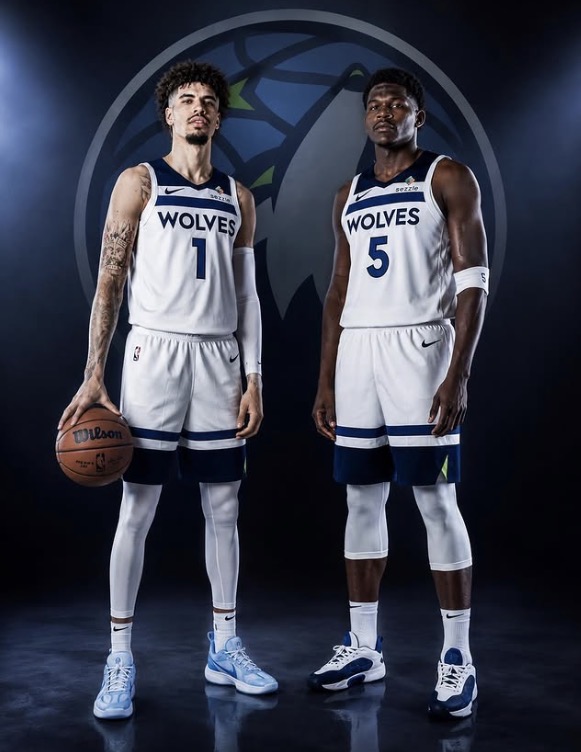
The NBA landscape shifted in a big way after the Charlotte Hornets traded franchise point guard LaMelo Ball to the Minnesota Timberwolves in exchange for Naz Reid and multiple draft picks. It’s a move that could dramatically change the direction of both organizations, but on paper, Minnesota appears to be the biggest winner.
LaMelo Ball has already established himself as one of the league’s most gifted playmakers. His ability to control the pace, create scoring opportunities for teammates, and score from anywhere on the floor makes him one of the NBA’s most exciting point guards. Last season, Ball averaged approximately 26 points, 7 assists, 5 rebounds, and nearly 2 steals per game while shooting around 40% from three-point range, proving he can impact the game in multiple ways.
Perhaps the most impressive statistic isn’t his individual numbers—it’s how much better Charlotte played whenever he was on the floor. The Hornets posted an outstanding 123.2 offensive rating with Ball directing the offense, which ranked as the best offensive efficiency in the NBA. When he was off the court, that number dropped to 110.6, ranking among the league’s worst. That dramatic difference highlights just how valuable Ball was to Charlotte’s offense.
Now that playmaking ability heads to Minnesota.
The Timberwolves have built one of the league’s strongest defensive teams around Anthony Edwards, Jaden McDaniels, Rudy Gobert, and their supporting cast. What they’ve lacked at times is an elite floor general who can consistently create easy baskets, push the tempo, and take pressure off Edwards as the primary ball-handler.
Ball immediately fills that need.
His creativity in transition should generate more fast-break opportunities, while his court vision will create easier scoring chances for Edwards, Gobert, and Minnesota’s shooters. Ball’s willingness to make highlight-reel passes forces defenses to stay alert, opening driving lanes and creating better spacing throughout the offense.
Anthony Edwards may be the biggest beneficiary. Instead of having to create nearly every offensive possession himself, Edwards can focus more on attacking defenses and scoring efficiently. That partnership has the potential to become one of the NBA’s most entertaining backcourts.
Of course, Ball’s durability has been questioned in previous seasons, but last year he answered many of those concerns by appearing in 72 games, his healthiest campaign since his All-Star season when he played 75 games. If he can remain healthy, Minnesota’s ceiling rises significantly.
For Charlotte, replacing Ball won’t be easy. Even though the Hornets still have talented young players like Brandon Miller, Kon Knueppel, and Miles Bridges, losing the player who orchestrated nearly every offensive possession leaves a major void. Re-signing Coby White adds depth, but replicating Ball’s unique combination of scoring and elite passing is a difficult task.
This trade signals that Minnesota is fully committed to competing for an NBA championship now. Adding one of the league’s premier playmakers gives the Timberwolves another offensive dimension while maintaining a roster capable of making a deep playoff run.
Only time will determine whether Charlotte’s gamble pays off, but one thing is certain: LaMelo Ball has the talent to elevate Minnesota into one of the most dangerous teams in the Western Conference.