The 2026 NBA Playoffs continue to deliver high-level intensity, and Sunday night’s Game 7 between the Cleveland Cavaliers and Toronto Raptors was no exception. Behind a dominant interior performance and timely shot-making, Cleveland pulled away for a 114–102 victory to advance to the Eastern Conference semifinals.
Jarrett Allen Anchors Cleveland’s Breakthrough
Jarrett Allen delivered one of the most impactful performances of his playoff career, finishing with 22 points and 19 rebounds—tying his postseason high. His presence on both ends, especially on the offensive glass (five offensive boards), shifted momentum during a decisive stretch.
Cleveland flipped the game with a staggering 49–21 run spanning the second and third quarters, turning a nine-point deficit into a commanding 19-point lead. Allen was at the center of that surge, controlling possessions and creating second-chance opportunities.
Balanced Scoring Lifts Cavaliers
Donovan Mitchell led the Cavaliers with 22 points, continuing to be the team’s steady offensive engine throughout the series. Meanwhile, James Harden added 18 points, providing veteran composure and timely perimeter shooting.
After struggling early from beyond the arc (4-of-17), Cleveland found rhythm late in the second quarter. Harden, Max Strus, and Jaylon Tyson each connected from deep, fueling an 11–2 run to close the half and tie the game at 49.
The Cavs then seized control early in the third quarter with a 9–0 burst, highlighted by Mitchell’s scoring and Evan Mobley contributing inside.
Raptors Show Fight but Fall Short
Despite the loss, Toronto showed resilience in its first playoff appearance since 2022. Scottie Barnes led the Raptors with 24 points and nine rebounds, while RJ Barrett added 23.
Toronto controlled much of the first half, even building a 10-point lead midway through the second quarter. However, their inability to sustain offensive efficiency during Cleveland’s run ultimately proved costly.
Detroit Pistons Await: A New Contender Emerges
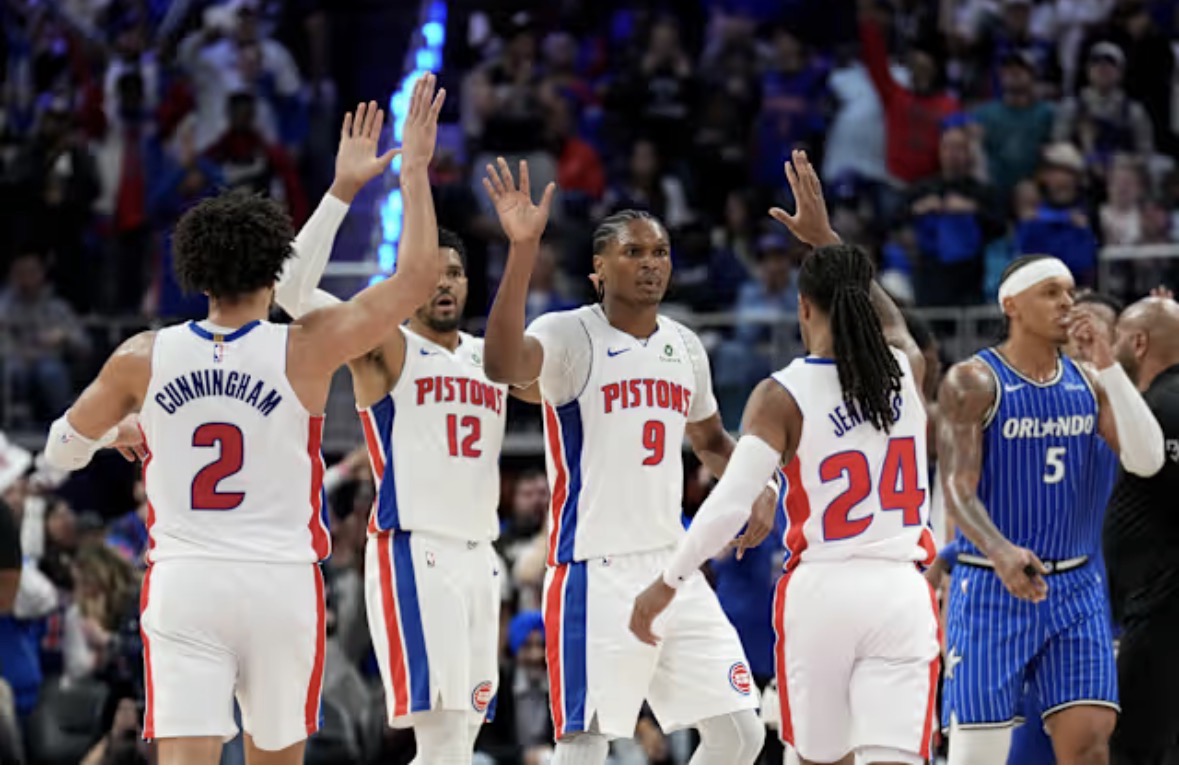
Cleveland now turns its attention to the top-seeded Detroit Pistons, who are coming off a statement series win of their own. Led by superstar guard Cade Cunningham, Detroit defeated the Orlando Magic 116–94 in Game 7.
Cunningham was sensational, posting 32 points and 12 assists, while averaging 32.4 points per game for the series. Tobias Harris added 30 points in the clincher, reinforcing Detroit’s offensive firepower.
The Pistons’ path to the semifinals was historic—they became just the 15th team in NBA history to overcome a 3–1 deficit. Their resilience was especially evident in Game 6, where they erased a 24-point deficit on the road.
Key Takeaways from Both Series
1. Interior Dominance Matters
Jarrett Allen’s Game 7 performance underscores how elite rebounding and paint control can dictate playoff outcomes. Cleveland’s +effort on the glass turned the tide.
2. Momentum Swings Decide Series
The Cavaliers’ 49–21 run highlights how quickly games—and series—can flip. Playoff basketball is often defined by short, explosive stretches.
3. Detroit is Peaking at the Right Time
Cade Cunningham is playing at an MVP level, and Detroit’s comeback from 3–1 signals a team with confidence and mental toughness.
4. Defense Wins in the Margins
Orlando’s offensive collapse—just 113 points over the final six quarters—shows how elite defensive adjustments can close out a series.
What to Watch: Cavaliers vs. Pistons
Game 1 tips off Tuesday at Little Caesars Arena, with Cleveland entering as the No. 4 seed against top-seeded Detroit. The teams split their regular-season series, setting up a compelling matchup.
- Can Jarrett Allen and Evan Mobley contain Detroit’s aggressive offense?
- Will Donovan Mitchell outduel Cade Cunningham in a battle of star guards?
- Which team controls tempo and physicality?
The Eastern Conference is shaping into a battle of resilience and star power. Cleveland proved it can respond under pressure, but Detroit’s momentum may be the most dangerous factor in the playoffs right now.