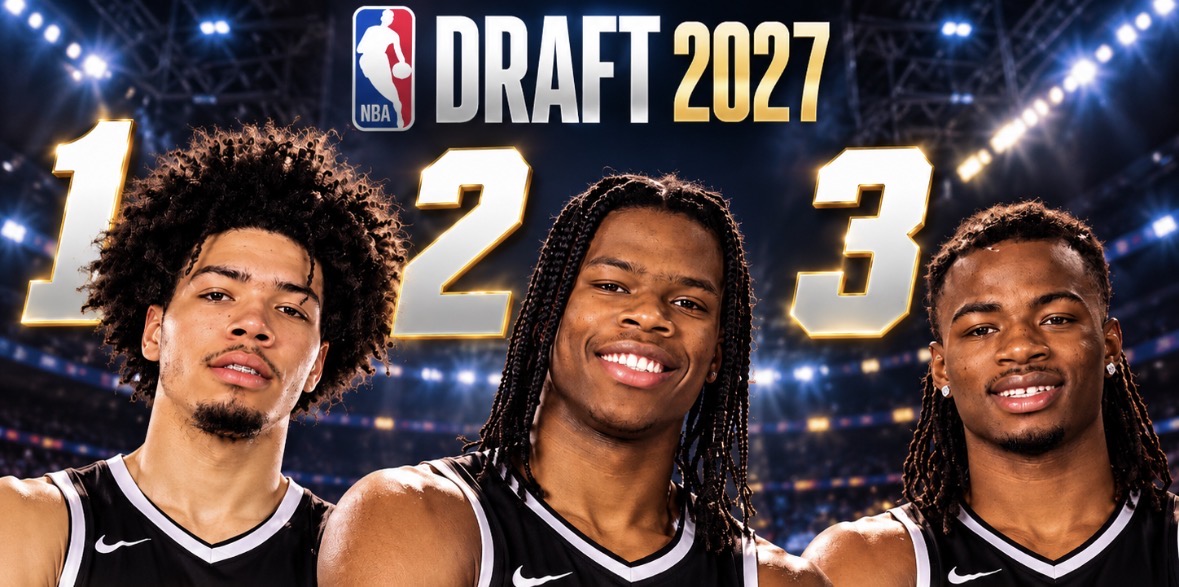
The race for the No. 1 overall selection in the 2027 NBA Draft is beginning to take shape, and three of college basketball’s most highly anticipated freshmen are positioned to become central figures in the discussion.
Kansas forward Tyran Stokes, Arizona guard Caleb Holt, and Arkansas guard Jordan Smith Jr. enter the 2026–27 college basketball season with impressive recruiting credentials, professional potential, and considerable expectations.
Each prospect brings a different dimension to the basketball court. Stokes combines physical strength with perimeter skills and offensive versatility. Holt has established himself as a dynamic two-way player with defensive intensity and an expanding offensive game. Smith offers explosive scoring, aggressive defensive pressure, and the ability to attack opponents off the dribble.
However, the NBA Draft is not simply about identifying the most productive college basketball player.
Professional organizations evaluate positional size, athleticism, shooting mechanics, decision-making, defensive versatility, basketball intelligence, and long-term developmental potential.
The central question is whether a player’s strengths will translate when facing bigger, stronger, and more experienced competition.
For Stokes, Holt, and Smith, their freshman seasons will provide an opportunity to demonstrate that their abilities extend beyond high school dominance.
The Hoop Post examines the strengths, weaknesses, college situations, and professional projections of three potential lottery selections in what appears to be an unpredictable 2027 draft class.
Tyran Stokes: Kansas’ Versatile Forward With No. 1 Pick Potential
Kansas Jayhawks | Freshman | 6-foot-8 | 230 pounds
Tyran Stokes enters Kansas with arguably the highest individual ceiling among the three prospects.
At 6-foot-8 and approximately 230 pounds, Stokes possesses the physical dimensions NBA organizations increasingly value in versatile forwards.
His combination of strength, mobility, ball-handling ability, and scoring potential allows him to influence games in multiple ways.
Unlike traditional forwards who primarily operate around the basket, Stokes can initiate offense from the perimeter, attack defenders off the dribble, and use his size to create advantages against smaller opponents.
That combination makes him particularly intriguing as the NBA continues emphasizing positionless basketball.
Offensive Strengths: Size, Power and Shot Creation
Stokes’ most impressive offensive characteristic is his ability to combine physicality with perimeter creativity.
He can attack the basket with strength, absorb contact, and create scoring opportunities through aggressive drives.
Against smaller defenders, his physical advantages become particularly noticeable. Against bigger opponents, his mobility and ball-handling ability create opportunities to attack from different areas of the floor.
His potential as a three-level scorer adds another dimension to his professional projection.
However, becoming a consistent perimeter scoring threat requires more than demonstrating the ability to make difficult jump shots.
Stokes must improve his shot selection and establish dependable shooting mechanics.
NBA defenders will be better equipped to contain straight-line drives and challenge contested attempts.
Developing a reliable catch-and-shoot jumper could dramatically increase his offensive value.
Playmaking and Basketball Decision-Making
Another intriguing aspect of Stokes’ game is his potential to function as a secondary offensive creator.
His size allows him to see over smaller defenders, while his handling ability gives him opportunities to initiate possessions.
Nevertheless, creating shots and directing an offense are different responsibilities.
NBA scouts will closely examine whether Stokes recognizes defensive rotations, makes timely passes, and avoids unnecessary turnovers.
At Kansas, he will have opportunities to demonstrate that he can contribute within an established offensive system rather than relying exclusively on individual talent.
His development under head coach Bill Self could be particularly important.
Self’s teams traditionally demand defensive accountability, disciplined execution, and an understanding of team responsibilities.
For Stokes, learning to balance creativity with structure will be an essential part of his freshman season.
Defensive Projection and Areas of Concern
Stokes possesses the physical tools to defend multiple positions.
His strength should help him compete against bigger wings, while his mobility provides the foundation to defend on the perimeter.
However, physical ability does not automatically translate into consistent defensive execution.
His defensive evaluation should focus on positioning, effort, communication, and awareness away from the basketball.
Can he maintain concentration through multiple defensive possessions?
Will he consistently close out on shooters without surrendering driving lanes?
Can he recognize screens and adjust when opponents force defensive switches?
These details will help determine whether Stokes develops into a complete two-way player.
The Hoop Post Projection: Stokes enters the season as the strongest No. 1 overall candidate of the three because his combination of size, offensive creation, and positional versatility offers the broadest potential NBA role.
His greatest developmental priorities are shooting consistency, decision-making, and sustained defensive engagement.
Caleb Holt: Arizona’s Two-Way Guard With Significant NBA Upside
Arizona Wildcats | Freshman | 6-foot-5 | 215 pounds
Caleb Holt enters Arizona as one of the most accomplished prospects in the freshman class.
The former Prolific Prep standout brings a combination of athleticism, defensive intensity, and competitive experience that should translate into immediate opportunities with the Wildcats.
His background includes high-level grassroots competition, national recognition, and international experience representing USA Basketball.
Holt also enters a program with an established reputation for developing professional prospects.
Under head coach Tommy Lloyd, Arizona has emphasized offensive movement, transition opportunities, unselfish basketball, and productive frontcourt play.
For Holt, that environment could provide an excellent opportunity to demonstrate his versatility.
Defensive Intensity Could Separate Holt From Other Prospects
Holt’s defensive potential is one of his strongest selling points.
At 6-foot-5, he possesses the size and physical strength to compete against different perimeter assignments.
His ability to apply pressure, contest shots, and create defensive disruption could become especially valuable against high-level college competition.
Modern NBA teams increasingly prioritize guards who can contribute offensively without becoming defensive liabilities.
Holt’s potential to defend multiple perimeter positions could make him attractive to organizations seeking players who can contribute in different lineup combinations.
However, the transition to college basketball will challenge his defensive discipline.
Aggressive defenders sometimes gamble for steals or become overly committed to individual matchups.
Holt must demonstrate that he can remain effective within Arizona’s defensive structure.
The distinction between creating spectacular defensive plays and consistently executing defensive responsibilities will become increasingly important.
Offensive Development: The Next Step Toward Stardom
Holt’s offensive game presents considerable potential, particularly when he attacks the basket and uses his athleticism to create scoring opportunities.
His ability to contribute without dominating the basketball is another positive characteristic.
He can generate value through transition opportunities, offensive rebounds, movement, and timely cuts.
However, the biggest question surrounding his long-term professional ceiling involves his ability to create offense consistently in half-court situations.
Can Holt develop into a reliable perimeter shooter?
Can he create separation against athletic defenders?
Will he become comfortable operating as a secondary ball handler?
Those questions will determine whether NBA teams evaluate him primarily as a versatile complementary player or someone capable of assuming a larger offensive role.
His outside shooting deserves particular attention.
Defenders at the professional level will challenge his ability to make perimeter shots consistently.
If Holt establishes dependable three-point shooting while maintaining his defensive impact, his draft value could rise significantly.
Why Arizona’s System Matters
Arizona offers Holt an opportunity to develop without carrying every offensive responsibility.
Playing alongside experienced teammates should allow him to learn how to recognize defensive coverages, operate within structured possessions, and contribute in different situations.
The Wildcats’ competitive Big 12 schedule will also provide valuable opportunities to evaluate Holt against strong, physical opponents.
His performance against established college guards and wings will offer a clearer picture of his NBA readiness than isolated scoring totals.
The Hoop Post Projection: Holt projects as a high-lottery candidate whose defensive versatility and all-around contributions could translate relatively quickly.
His path toward becoming a serious No. 1 overall contender depends on developing more advanced shot creation and reliable perimeter scoring.
Jordan Smith Jr.: Arkansas’ Explosive Guard Looking to Become an NBA Star
Arkansas Razorbacks | Freshman | 6-foot-2 | 210 pounds
Jordan Smith Jr. enters Arkansas with an impressive basketball résumé and significant expectations.
The former Paul VI Catholic standout earned national high school recognition and established himself as one of the most accomplished guards in his recruiting class.
At Arkansas, Smith will play for John Calipari, a coach with extensive experience developing talented guards for professional basketball.
The Razorbacks offer an environment where Smith can showcase his offensive creativity, competitive intensity, and defensive abilities.
However, his professional projection presents a different challenge from those facing Stokes and Holt.
At 6-foot-2, Smith must demonstrate that his skills can overcome the positional size advantages possessed by many NBA perimeter players.
Explosive Scoring and Rim Pressure
Smith’s ability to attack the basket represents one of the most appealing aspects of his offensive game.
His combination of strength, acceleration, and aggressive ball handling allows him to pressure defenders.
He is capable of creating opportunities by changing pace, attacking openings, and using his physicality around the basket.
That attacking mentality can be valuable in college basketball, particularly when opposing defenses struggle to contain penetration.
However, NBA defenses are significantly more sophisticated.
Professional defenders can recover more quickly, protect driving lanes, and challenge shots around the basket.
Smith must demonstrate that he can finish efficiently against bigger defenders while also recognizing opportunities to create shots for teammates.
Developing a consistent perimeter jumper will be another important factor.
If defenders are forced to respect his outside shooting, his ability to attack the basket becomes considerably more dangerous.
Can Smith Become a True NBA Lead Guard?
Perhaps the most important question surrounding Smith involves his long-term position.
Is he best suited to becoming a primary point guard, or will his professional value come from functioning as a scoring-oriented combination guard?
His freshman season should provide important evidence.
NBA teams will examine his assist-to-turnover relationship, passing decisions, ability to organize an offense, and effectiveness in pick-and-roll situations.
A talented scorer can dominate individual possessions.
A successful NBA point guard must also understand how to create efficient opportunities for teammates.
Smith’s ability to balance those responsibilities will significantly influence his draft projection.
Defensive Pressure and Competitive Identity
Smith’s defensive potential provides another reason for optimism.
His physical strength and aggressive approach can create problems for opposing ball handlers.
He has the tools to pressure opponents, disrupt passing lanes, and compete through contact.
However, defensive versatility may be more limited because of his height.
NBA organizations will evaluate whether he can consistently defend bigger guards, navigate screens, and maintain effectiveness without committing unnecessary fouls.
His defensive effort will be important, but his positioning and decision-making could become equally significant.
The Hoop Post Projection: Smith enters the season as a legitimate high-lottery prospect with the potential to challenge for the top selection.
His ability to improve as a facilitator, establish shooting consistency, and demonstrate defensive reliability against bigger opponents will shape his professional ceiling.
Head-to-Head: Which Prospect Has the Strongest NBA Profile?
The differences between these three prospects become clearer when examining how their abilities could translate to the professional game.
Stokes offers the most intriguing combination of physical dimensions and offensive creation.
Holt provides an attractive balance of defensive potential, versatility, and complementary offensive skills.
Smith brings dynamic guard play, downhill scoring, and defensive aggression.
Each player has a plausible pathway toward becoming an impact NBA contributor.
However, their developmental priorities are different.
For Stokes, the primary challenge is converting his versatility into efficient, disciplined basketball.
For Holt, the question is whether he can develop enough offensive creation to become more than a high-level complementary player.
For Smith, the challenge is demonstrating that he can control an offense while remaining effective against bigger defenders.
The college season will provide valuable evidence, but it is important to recognize that draft evaluations remain fluid.
A player’s draft position should not be determined exclusively by early-season scoring performances or national recruiting rankings.
Consistency, improvement, and performance against elite competition should carry considerable weight.
The Big 12 and SEC Will Provide Important Tests
Stokes and Holt will compete in the Big 12, giving scouts opportunities to evaluate them against many of the same conference opponents.
Their performances against physical defenses and experienced college players could help clarify the differences between their respective games.
Meanwhile, Smith will face the demands of SEC competition, where athleticism, physicality, and defensive pressure will test his decision-making.
These environments should reveal whether each prospect can adapt when opponents take away preferred scoring opportunities.
Scouts should pay particular attention to how the three respond to difficult performances.
Do they become more effective as games progress?
Can they contribute when their jump shots are not falling?
Are they willing to defend, rebound, and make productive passes when offensive opportunities become limited?
Those characteristics can help distinguish talented prospects from players capable of becoming reliable professionals.
The Hoop Post Final Take: Who Deserves the No. 1 Ranking?
Entering the 2026–27 college basketball season, The Hoop Post gives Tyran Stokes the early advantage in the race among these three prospects.
His combination of size, strength, ball-handling ability, and potential offensive versatility provides the strongest foundation for a high-ceiling NBA projection.
Caleb Holt follows closely because of his defensive potential, physical tools, and ability to contribute in multiple areas.
Jordan Smith Jr. remains a serious contender, particularly if he demonstrates that he can become an efficient lead guard while maintaining his scoring aggression.
The Hoop Post’s preliminary ranking:
- Tyran Stokes — Kansas: Highest overall ceiling based on positional size and offensive versatility.
- Caleb Holt — Arizona: Strongest projection as a versatile two-way perimeter contributor.
- Jordan Smith Jr. — Arkansas: Dynamic scoring guard with significant upside if his playmaking develops.
These rankings are not final predictions of where the players will be selected.
The 2027 NBA Draft remains months away, and all three prospects have important developmental questions to answer.
What makes this competition compelling is that no single player has established an insurmountable advantage.
Stokes may possess the highest ceiling today, but Holt and Smith have opportunities to challenge that position.
Ultimately, the deciding factor will not be recruiting reputation or preseason publicity.
It will be which player demonstrates the greatest ability to translate individual talent into efficient, winning basketball.
For The Hoop Post, this is only the beginning of the evaluation process.
The Hoop Post NBA Draft Watch will continue following these prospects throughout the college basketball season as their professional futures come into focus.